How to Play Puli Meka
Puli Meka means “tiger and goat” in Telugu. It is a hunt game from Andhra Pradesh and Telangana, played on a triangle scratched into the ground or drawn on a slate. One player has 3 tigers, the other has 15 goats. The tigers want to eat goats. The goats want to box the tigers in so they can’t move.
The two sides play very differently, which is half the fun: try both.
Quick Overview
- Players: 2, one plays the tigers and one the goats
- Pieces: 3 tigers and 15 goats
- Tigers win by capturing 6 goats
- Goats win by trapping the tigers so none of them can move
- Time: 10 to 20 minutes
The Board
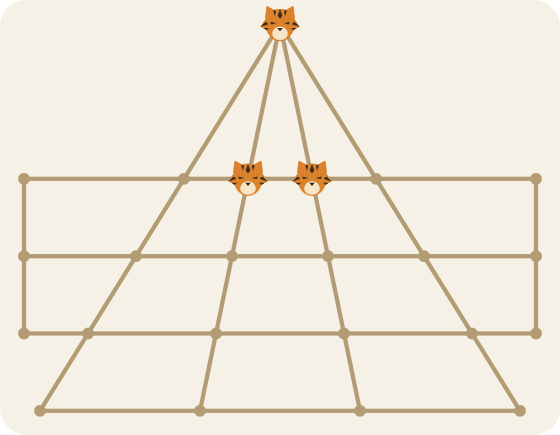
The board has 23 points joined by lines. Four lines fan out from the point at the top (the apex), four rows run across, and two short columns stand at the sides. Pieces always sit on the points and move along the lines.
Setup
The tigers start on the board: one on the apex and two on the points just below it. All 15 goats start off the board, waiting to be placed.
The person who creates the game picks which side they play, or leaves it to chance. You can see who has which side in the waiting room.
Taking a Turn
Goats move first, then the two sides take turns.
Goats
- Placing. While you still have goats to place, each turn you put one goat on any empty point.
- Moving. Once all 15 are placed, each turn you move one goat one step along a line to an empty point next to it.
Goats never jump and never capture.
Tigers
On each turn, a tiger can either:
- Step one point along a line to an empty point next to it, or
- Jump over a goat to capture it.
Tigers can move and capture from the very first turn, while the goats are still being placed.
Capturing
A tiger captures by jumping. The goat must be on the very next point along a line, and the point straight beyond it on the same line must be empty. The tiger jumps over the goat, lands on the empty point, and the goat is taken off the board.
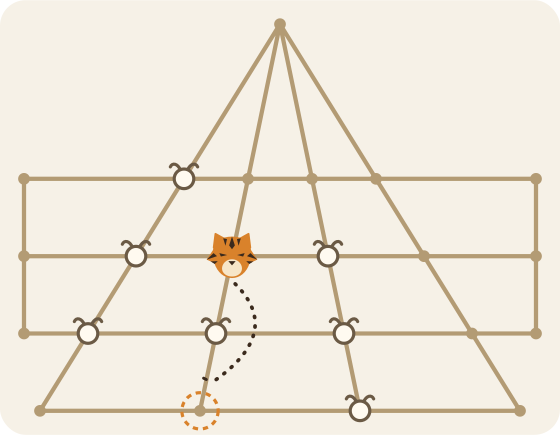
A jump must be in a straight line: you can’t turn a corner mid-jump. By default a tiger makes only one jump per turn, and capturing is optional.
Captured goats are gone for good. A captured goat doesn’t come back: it still counts as one of the 15 placed.
Winning
- The tigers win when they have captured 6 goats.
- The goats win when it is the tigers’ turn and no tiger can move or jump.
- If it is the goats’ turn and no goat can move, the tigers win.
Draws
So that a game can’t go on forever, it is a draw if:
- The same position comes up three times, with the same side to move, or
- 50 moves pass without a capture (25 for each side). This count only starts once every goat has been placed.
When Your Time Runs Out
Turns are untimed unless the person who created the game chose a time limit (30, 60 or 120 seconds). With a time limit, if your clock runs out, you lose.
Leaving
If a player leaves a game in progress, the other player wins.
Playing Again
When a game ends, either player can press Play again, swap sides. That sets up a new game with the same options, with each of you on the other side. The other player gets a button to join it.
Options
The person creating the game can change these. The rules above are the defaults.
You play
Choose Tigers, Goats or Random. With Random, sides are picked when the game starts.
Tigers win after capturing
How many goats the tigers need: 5, 6 (the default), 7, or All 15. A lower number helps the tigers. A higher number gives the goats more room for mistakes.
Tigers start
- On the board (the default): the tigers start on the apex and the two points below it.
- One at a time: the tigers start off the board too. On each of their first three turns, the tigers place one tiger on any empty point, and they can’t move or capture until all three are on the board.
Time per turn
Off (the default), 30s, 60s or 120s. Run out of time and you lose.
Compulsory capture
When this is on and a tiger can capture, the tigers must jump. Goats can use this to pull a tiger out of position.
Multi-jump
When this is on, a tiger that has just captured may keep jumping, capturing another goat with each jump, all in the same turn. It can stop whenever it likes, unless Compulsory capture is also on, when it must keep jumping while it can.
Rules Vary by Region
Puli Meka is a folk game, so every village has its own version. Some play with a different number of goats or tigers, start the tigers elsewhere, or play until every goat is taken. The defaults here follow a common South Indian version. The options cover the most common differences.
The same game, or close cousins of it, has other names:
- Aadu Puli Attam (“goat and tiger game”) in Tamil Nadu
- Lambs and Tigers, or Goats and Tigers, in English
- Bagh-Chal (“tiger moves”) in Nepal, a cousin played on a square 5×5 grid with 4 tigers and 20 goats
Tips
Playing the goats
- Place goats where they back each other up. A goat with another goat or the board’s edge behind it can’t be jumped from the front.
- Fill the bottom of the board first, then close in on the tigers row by row.
- Don’t rush. A single gap can let a tiger jump through, and the tigers only need a few goats.
Playing the tigers
- Keep your tigers spread out and away from the edges, where they are easy to trap.
- Look for two goats at once: a move that threatens two jumps is hard for the goats to stop.
- Capture early, while the goats are still being placed and the board is open.